
Secrets keep themselves. If the accounts of a Hungarian shaman named Yoshka Soos are not an isolated case, and "masters of sound" really do work with singing bowls behind closed doors in Tibetan monasteries, it's little wonder they guard their knowledge closely — at least where singing bowls are concerned. Soos is not the only witness to describe such figures; other travelers and researchers have reported similar encounters, though hard documentation remains scarce.
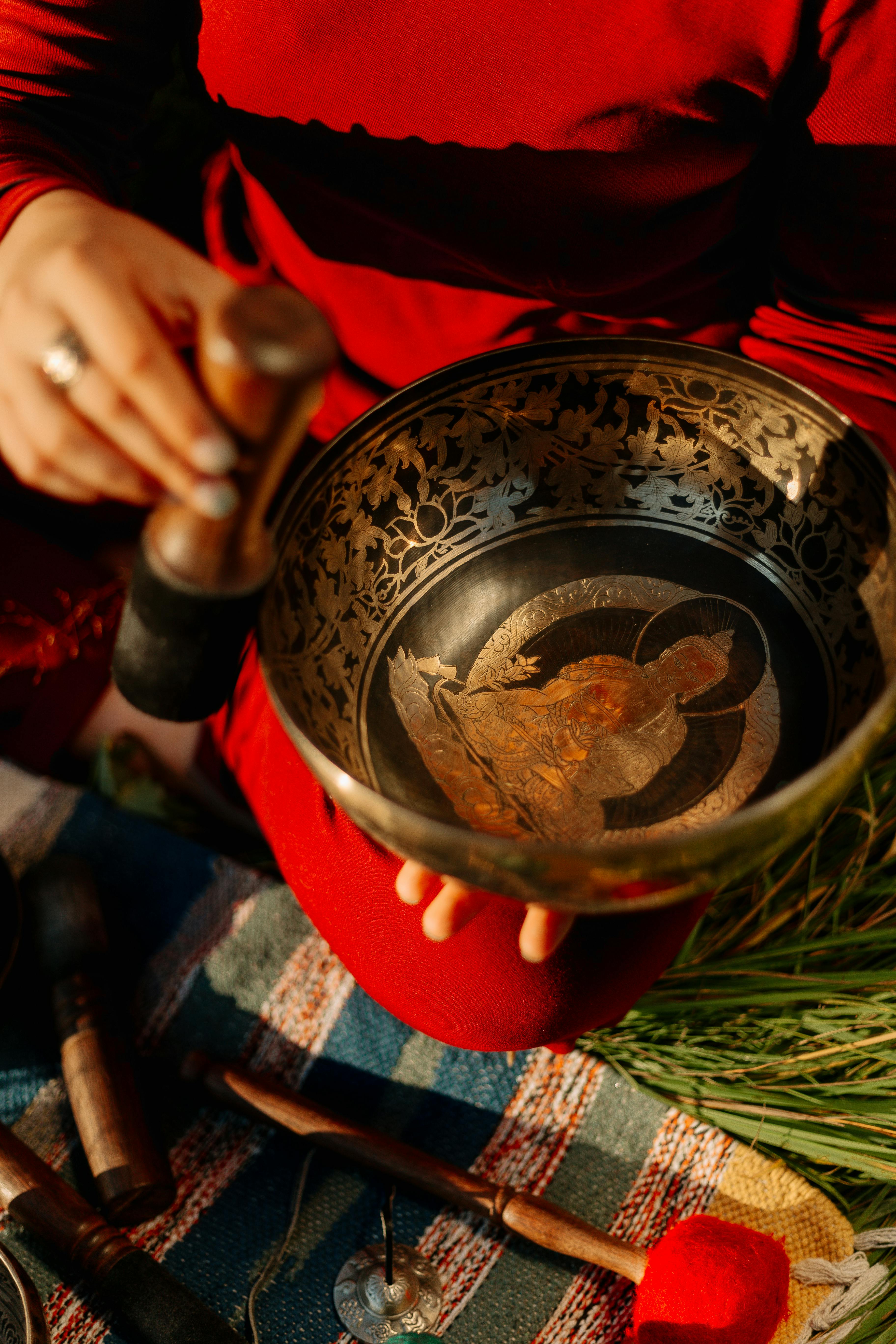
An Orchestra of the Body
One of the more evocative accounts comes from Erik Bruijn, who in his book on Tibetan tantra, yoga and meditation describes the symbolic construction of an orchestra in a Tibetan temple. He explains that the sounds produced by musical instruments are meant to be an exact copy of internal sounds that can be discovered in the body during complete stillness. Block out the noise of the outside world, and you can hear the hum of circulating blood and the rhythm of your own heartbeat. Experienced monks and yogis, trained to direct their concentration inward for long periods, learn to identify barely perceptible vibrations produced by these organic processes — and Tibetan musical aesthetics describes them with remarkable precision: singing, percussive, dull, ringing, chiming, wailing and trumpeting sounds.
Music as a Mirror of the Body
According to this tradition, musical instruments — including singing bowls — are built and played to reproduce these internal sounds as faithfully as possible. In other words, the "voice" of a well-made bowl isn't arbitrary; it's understood as an echo of processes already happening inside a meditating body. Whether or not every claim about hidden monastery workshops can be verified, this idea reframes the singing bowl: not simply an instrument played at you, but a mirror of something already present within.
Why This Matters for Modern Listeners
You don't need to track down a secretive lineage of monks to benefit from this perspective. The next time you play a singing bowl, try listening not just to the sound in the room, but to how your own body responds — your breathing, your pulse, the tension in your shoulders. That inward listening is, in essence, the same practice these "masters of sound" are said to have refined over lifetimes.


